 Coil
Best Metal Detector for Gold: Prospecting Detectors Compared
Researched guide: written from manufacturer documentation and the sources listed at the end, not from hands-on testing of every product. Facts last checked November 25, 2026. Some links are affiliate links; see the disclosure.
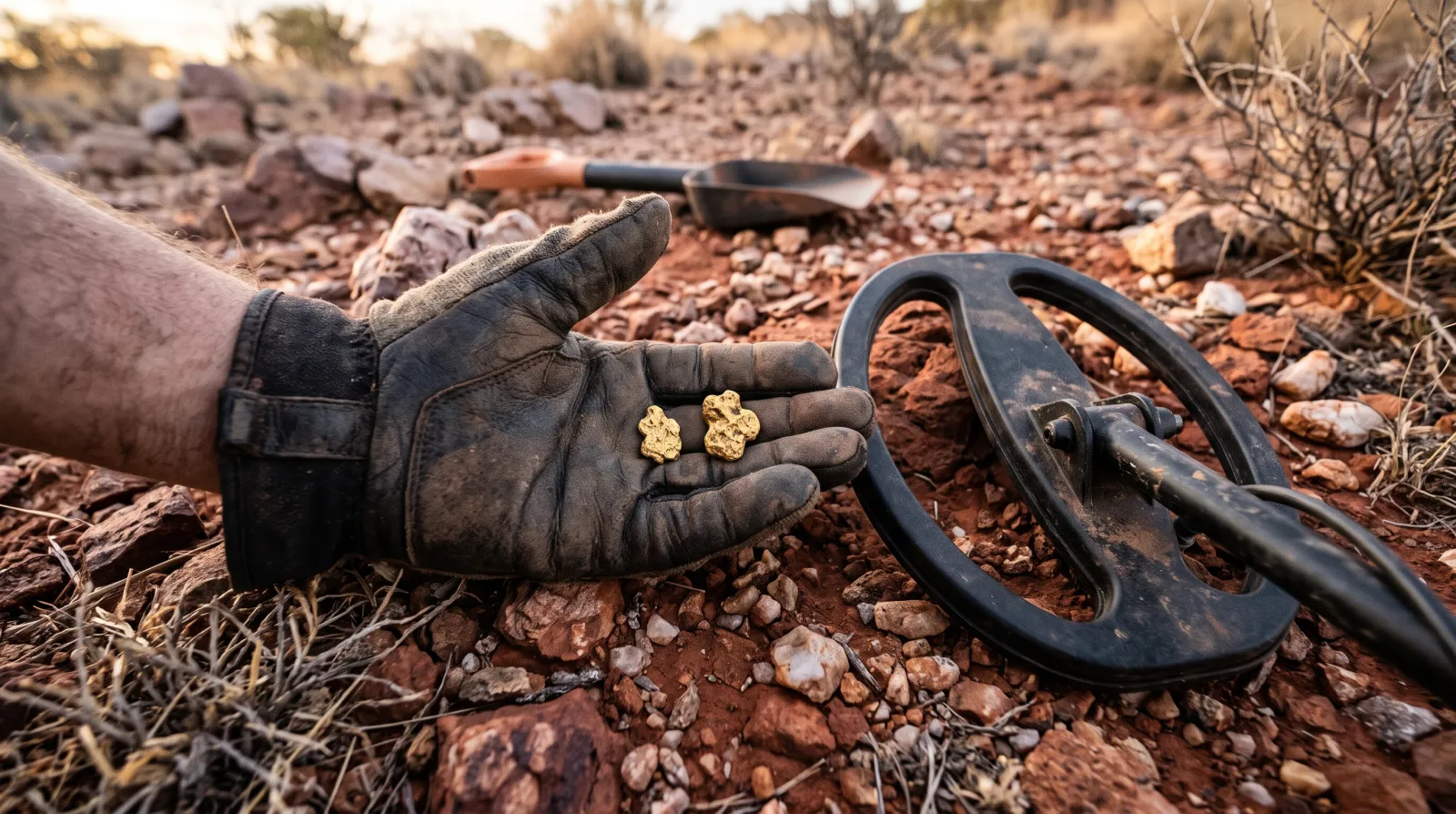
Gold nuggets are among the hardest targets in detecting. They are often small, they sit in ground full of iron minerals that confuse ordinary detectors, and a nugget the size of a match head gives a faint signal. Detectors built for gold deal with all three problems.
The details below come from manufacturer specifications. We have not field-tested these detectors. If you are new to detecting, start with metal detecting for beginners.
What makes a detector good for gold
- High frequency or pulse induction. Higher-frequency VLF detectors are more sensitive to small, low-conductivity targets such as fine gold. Pulse induction (PI) detectors work differently and see deeper through mineralized ground.
- Ground balance that keeps up. Gold country soil is often heavily mineralized. Good gold detectors balance to the ground automatically or track it as you move.
- Small-target sensitivity. Adjustable or automatic sensitivity, plus an all-metal mode, because discrimination can reject tiny gold along with the trash.
- A coil that suits the ground. Small coils find small gold in rocky spots; larger coils cover more ground and go deeper.
VLF vs PI at a glance
| VLF gold detector | PI gold detector | |
|---|---|---|
| Small surface gold | Very sensitive | Good |
| Heavily mineralized ground | Can struggle | Handles it well |
| Depth on larger nuggets | Moderate | Greater |
| Weight | Lighter | Heavier |
| Trash rejection | Better | Limited, more digging |
| Typical user | Beginners, small gold, trashy areas | Serious prospectors on proven ground |
Minelab’s Gold Monster 2000 sits between the two: Minelab describes its Multi-Au technology as combining VLF sensitivity with a pulse induction soil-handling engine.
Quick comparison
| Detector | Technology | Frequency | Waterproof | Best for |
|---|---|---|---|---|
| Minelab Gold Monster 1000 | VLF | 45 kHz | Coil to 1 m; box splash-proof | Easiest automatic start |
| Garrett AT Gold | VLF | Not stated by Garrett | To 10 ft (3 m) | Streams and wet ground |
| Nokta Gold Kruzer | VLF | 61 kHz | IP68, to 5 m (16.4 ft) | Small gold, two coils included |
| Fisher Gold Bug 2 | VLF | 71 kHz | Coil waterproof | Tiny gold, experienced users |
| Minelab Equinox 900 | Multi-frequency | Multi-IQ | IP68, to 5 m (16 ft) | Gold plus coins, relics and beach |
| Minelab GPX 6000 | Pulse induction | PI | Coil to 1 m; box splash-proof | Serious nugget hunting |
1. Minelab Gold Monster 1000: easiest start
Check the Gold Monster 1000 on Amazon
Minelab calls the Gold Monster 1000 an “easy automatic small gold hunter”. It runs at 45 kHz and does most of the setup itself: automatic ground balance, automatic noise cancel, and automatic or manual sensitivity. A Gold Chance Indicator gives a hint whether a signal is likely gold.
Per Minelab’s specifications it weighs 1.33 kg (2.94 lb), comes with a 5 inch round Double-D coil, and runs on a removable lithium-ion pack or 8 AA batteries. The coil is waterproof to 1 m; the control box is splash and rain proof.
If you want the newer version of the idea, the Gold Monster 2000 adds Minelab’s VLF/PI hybrid and manual ground balance options.
Good for: beginners who want to learn gold country, not detector settings.
2. Garrett AT Gold: built for wet ground
Check the Garrett AT Gold on Amazon
The AT Gold is a VLF detector that, according to Garrett’s manual, operates at a high frequency optimized for gold prospecting. Its standout feature is waterproofing to 10 feet (3 m), useful when you follow gold into streams and creek beds. The stock headphones are not waterproof.
Garrett lists manual and automatic ground balance, a True All Metal mode with proportional audio, and a 5 x 8 inch DD coil. It runs on four AA batteries; the manual estimates 20 to 40 hours depending on the batteries. Garrett’s warranty on its hobby detectors is three years.
Good for: prospecting along streams and anyone who also wants a capable coin and relic detector.
3. Nokta Gold Kruzer: small gold, two coils
Check the Nokta Gold Kruzer on Amazon
The Gold Kruzer runs at 61 kHz, the higher end for VLF, which favors small gold. Nokta rates it IP68, fully submersible to 5 m (16.4 ft), and lists a weight of 1.4 kg (3 lb) including coil and batteries.
It comes with two waterproof coils, a 26 x 14 cm concentric and a 19 x 10 cm DD, so you can switch between open ground and tight, rocky spots. Ground balance can be automatic, manual or tracking, and there are four search modes. Nokta quotes up to 19 hours from its built-in lithium polymer battery.
Good for: hunters who want a high-frequency, fully waterproof gold machine with two coils in the box.
4. Fisher Gold Bug 2: tiny gold specialist
Check the Fisher Gold Bug 2 on Amazon
At 71 kHz, the Gold Bug 2 has the highest frequency in this list, aimed squarely at very small gold. It is an older, more hands-on design: manual ground balance with a dual-knob control, three modes, and a waterproof 10 inch elliptical coil. Fisher lists a weight of 2.9 lb and up to 35 hours on two 9V batteries.
Manual ground balance takes practice, so this is a better second detector than a first one. On the official store, only the 10 inch coil version was in stock when we checked.
Good for: experienced users chasing the smallest nuggets.
5. Minelab Equinox 900: gold plus everything else
Check the Equinox 900 on Amazon
Not a dedicated gold detector, but Minelab gives it a Gold mode next to Park, Field and Beach modes, and lists it in its gold prospecting lineup. Gold mode, according to Minelab, adds sensitivity in mineralized soils for small targets. It is waterproof to 5 m (16 ft) and also covers single frequencies from 4 to 40 kHz.
We cover it in more detail in our beach detector guide.
Good for: people who want one detector for gold trips, parks and beaches.
6. Minelab GPX 6000: serious nugget hunting
The GPX 6000 is a pulse induction detector using Minelab’s GeoSense-PI. PI is the usual choice for larger, deeper nuggets in heavily mineralized ground. Minelab lists three ground type modes (Normal, Difficult, Severe), automatic ground balance and automatic noise cancel.
Per Minelab’s specifications it weighs 2.1 kg (4.6 lb), runs up to 8 hours on a removable lithium-ion pack, and ships with 14 inch Double-D and 11 inch Monoloop coils; bundles can vary by market. Minelab’s top tier goes further with the GPZ series, its current flagship being the GPZ 8000.
Good for: prospectors who already know they will spend many days on gold ground.
Where you can detect for gold
Before you go, make sure the ground is open to you:
- BLM land. Federal rules count the use of metal detectors and other battery-operated devices for sensing minerals as “casual use”, which generally needs no permit when it causes no more than negligible disturbance. BLM allows reasonable amounts of gold for personal use, not for sale.
- Mining claims. Much productive gold ground is under active claims. BLM says collecting there is prohibited without the claimholder’s permission. Check claim status with the BLM state office before you dig.
- National parks are closed to prospecting, according to the USGS.
- Artifacts. Federal law makes it illegal to remove or damage archaeological items, whatever the land rules for gold.
- Private land needs the owner’s permission.
Our metal detecting laws guide covers federal land rules in more detail.
Which one should you get?
- First gold detector, minimal settings: Minelab Gold Monster 1000.
- Streams and wet ground: Garrett AT Gold or Nokta Gold Kruzer.
- Smallest gold, and you like manual control: Fisher Gold Bug 2.
- One detector for gold and everything else: Minelab Equinox 900.
- Serious prospecting in mineralized ground: Minelab GPX 6000.
Add a pinpointer, a sturdy digging tool and a magnet for clearing iron from your holes; our supplies list covers the rest.
Get new guides by email
One short email a week with new detecting, rockhounding and tumbling guides. You also get our printable rock tumbling grit schedule.
No spam. Unsubscribe anytime. Privacy
Frequently asked questions
What is the best metal detector for gold for a beginner?
A high-frequency VLF gold detector with automatic settings, such as the Minelab Gold Monster 1000, is the easiest start. It handles ground balance and sensitivity for you, so you can concentrate on learning where gold is found.
Can a regular metal detector find gold?
Yes, but small nuggets are hard for detectors tuned for coins. Gold-focused detectors run at higher frequencies or use pulse induction, and they cope better with the mineralized ground where gold is usually found.
VLF or PI for gold?
VLF detectors are lighter and very sensitive to small gold near the surface. Pulse induction (PI) detectors handle heavily mineralized ground and reach larger nuggets at greater depth, but they are heavier and dig more trash.
Where can I metal detect for gold?
On much BLM land, metal detecting for minerals counts as casual use, and BLM allows reasonable amounts of gold for personal use. National parks are closed to prospecting, and you need the claimholder's permission on active mining claims.
Sources
- Minelab: Gold Monster 1000 tech specs
- Minelab: Gold Monster 2000
- Minelab: GPX 6000 tech specs
- Minelab: Equinox 900
- Garrett: AT Gold
- Garrett: AT Gold owner's manual (PDF)
- Nokta: Gold Kruzer
- First Texas (Fisher): Gold Bug 2
- eCFR via Cornell LII: 43 CFR 3809.5 (casual use)
- Bureau of Land Management: Can I keep this?
- USGS: Prospecting for gold in the United States