 Coil
How Deep Does a Metal Detector Go? Real Depths and What Changes Them
Researched guide: written from manufacturer documentation and the sources listed at the end. Facts last checked November 26, 2026.
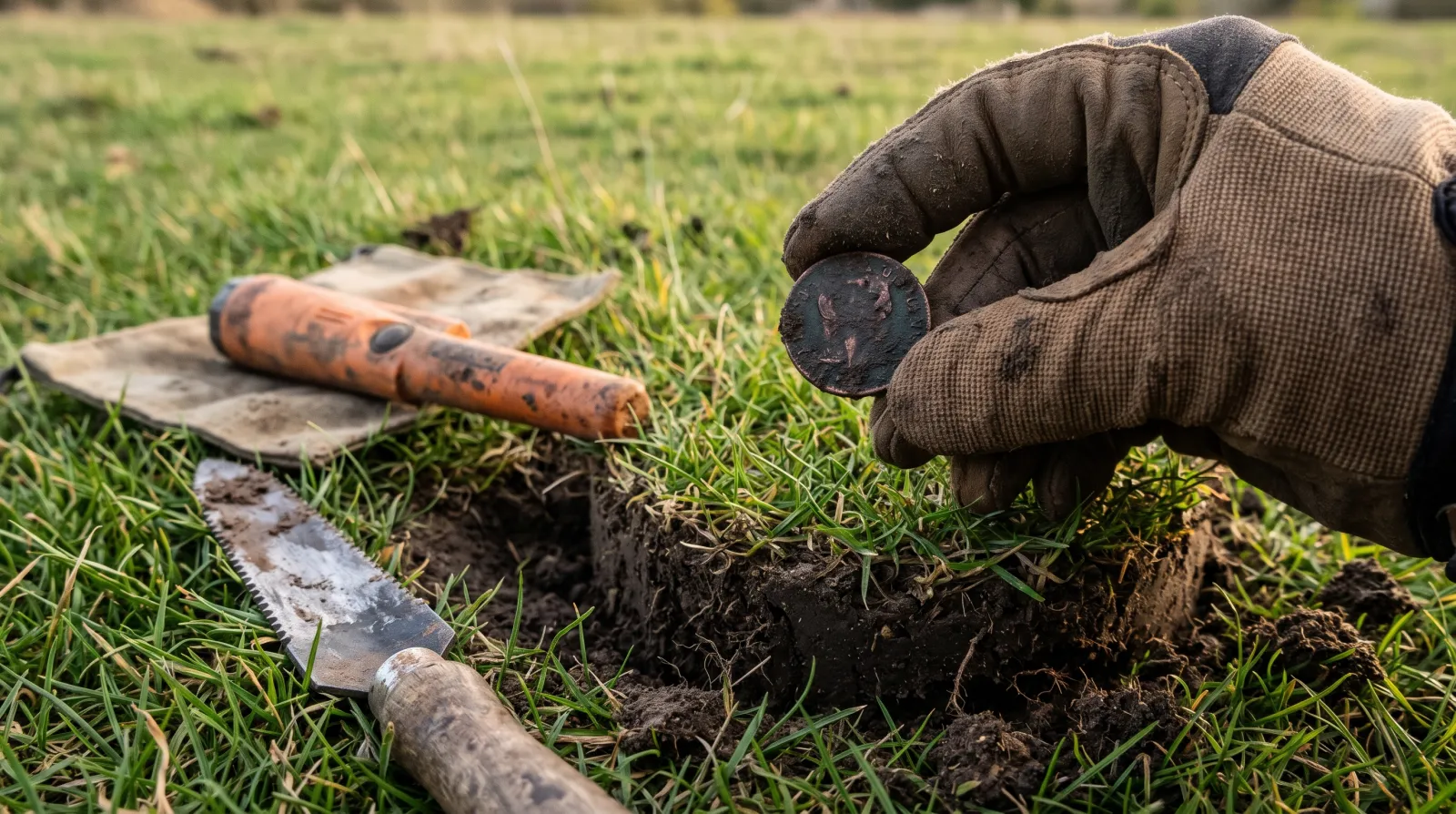
There’s no single answer to how deep a metal detector goes. Minelab says it depends on target size, orientation, metal, ground minerals, conductivity and electrical noise. Garrett says it’s impossible to predict with complete certainty. What manufacturers do give are typical ranges and the factors that push depth up or down.
Typical depths
| Target | Typical depth (manufacturer figures) | Source |
|---|---|---|
| Coins, most hobby detectors | About 6 to 12 inches in optimal conditions | Minelab |
| Objects in general, typical detectors | About 10 to 16 inches | Garrett |
| Coin with a coil of diameter X | About X inches, up to roughly a 15-inch coil | Garrett rule of thumb |
| Large gold nuggets, PI gold detector | Reports of 3 to 4 feet | Minelab (anecdotal) |
Treat these as ballparks. Minelab’s anecdote about large nuggets at 3 to 4 feet is what owners report, not a specification.
Two-box detectors are built for large, deep objects and ignore items under about 3 inches across, according to Garrett. We found no manufacturer depth figure for them.
What changes detection depth
Target size and shape
Bigger targets are found deeper. Minelab says larger targets reflect more signal energy, and flat, broad surfaces are easier to detect than thin or irregular items. Fisher adds that a coin lying flat shows more surface to the coil, while rod-shaped items scanned end-on are very hard to detect. Orientation changes the signal too.
The metal itself
Minelab says highly conductive metals like silver and copper give stronger signals and more depth, while lower-conductivity metals like gold can be harder to detect.
Soil and moisture
Mineralized soil is the biggest depth killer. Garrett says highly mineralized soil can reduce penetration and may require ground balancing. Minelab puts it more precisely: depth is relative to ground noise, and if the ground signal is as strong as the target signal, you can’t tell the target apart. Moist soil, on the other hand, can improve conductivity and depth, according to both Garrett and Minelab.
How fast the signal fades
Signal strength falls off very steeply with distance. Minelab’s engineering paper shows that, for a small target under an 11-inch coil, going about 12 percent deeper halves the signal, and about 47 percent deeper makes it ten times weaker. That’s why the last few inches of depth are so hard to gain.
Coil size and type
- Size. Garrett’s rule of thumb: a coil finds a coin-sized object at about its own diameter, so a 4-inch coil reaches a quarter at about 4 inches and a 12-inch coil at about 12 inches. Above about 15 inches, the field gets less concentrated and starts missing small objects, though large objects can still be found. Fisher puts the gain from a larger coil more modestly, at 5 to 15 percent.
- Type. Garrett says a concentric coil gives the largest detection field and depth over clean ground, but loses performance in mineralized ground, where a Double-D coil significantly outperforms it. Minelab says mono coils on PI detectors tend to give slightly more depth than Double-D coils.
- Trade-offs. Large coils struggle in trashy areas and are more prone to electrical interference, Garrett and Minelab note. Small coils are best for very small objects.
Frequency
Lower frequencies penetrate deeper on large, conductive targets such as silver coins; higher frequencies are more sensitive to small, thin items but with less depth, according to Minelab and Garrett. Nokta’s manual gives 4 kHz as its setting for more depth on larger silver coins and relics. For more on frequencies, see types of metal detectors.
Settings
- Sensitivity. Higher sensitivity gives more depth, but Garrett, Fisher and Nokta all warn that too much causes false signals in mineralized soil or near power lines, and you may miss more than you gain.
- Discrimination. Garrett’s FAQ answers plainly that depth is compromised when you use discrimination. Its AT Max manual says All Metal mode gives the greatest detection depth.
Time in the ground
Freshly buried targets are harder to detect. Garrett’s Master Hunters manual says newly buried coins are somewhat harder to detect than items buried for some time, and a White’s manual says it can take years for freshly buried targets to respond at true depth. Fisher calls this the “halo effect”: corrosion spreads into the surrounding soil and makes an old object appear larger.
Technique and interference
Minelab says to keep the coil parallel to the ground, at a steady height and an even sweep speed. Power lines and other electrical sources cause interference that costs depth, especially with sensitive PI detectors.
How accurate are depth readings?
Most detectors show an estimated depth, but it’s a guide only:
- Garrett says its depth indicator is calibrated for coin-sized targets: larger targets may read shallower than they are, and smaller targets deeper.
- Nokta says its estimate assumes a 1-inch coin, and that the reading can change with the operating frequency.
- Minelab calls its depth gauge an approximate indication, inaccurate for large or small metals.
- Garrett and Nokta both note that a detector can hear a target deeper than it can identify it, so a faint signal with no target ID may still be worth digging.
How to get more depth
- Ground balance carefully, especially in mineralized soil.
- Use All Metal mode or less discrimination on promising ground.
- Raise sensitivity until the detector gets chatty, then back off.
- Try a lower frequency for large, deep targets.
- Keep the coil low, level and moving steadily.
- Use a larger coil on clean, open ground, and a smaller one in trash.
Choosing a detector? See the best metal detector for beginners, or for nuggets, the best metal detector for gold.
Get new guides by email
One short email a week with new detecting, rockhounding and tumbling guides. You also get our printable rock tumbling grit schedule.
No spam. Unsubscribe anytime. Privacy
Frequently asked questions
How deep does a metal detector go?
For coins, most hobby detectors reach somewhere around 6 to 12 inches in good conditions, according to Minelab, and Garrett says detectors typically find objects 10 to 16 inches deep. Larger objects can be found much deeper, and specialist gold detectors can go further still.
Does a bigger coil go deeper?
Yes, up to a point. Garrett's rule of thumb is that a coil detects a coin-sized object at about its own diameter, but above roughly 15 inches the field spreads out and starts missing small objects. Fisher puts the gain from a larger coil at 5 to 15 percent.
How accurate is the depth reading on a metal detector?
It's an estimate. Detectors calibrate the depth reading for a coin-sized target, so Garrett and Nokta both say larger objects read shallower than they are and smaller ones read deeper.
Why do old coins seem easier to find than newly dropped ones?
Manufacturers say freshly buried targets respond less well than items that have been in the ground for years. Fisher attributes this to the 'halo effect', where corrosion spreads into the soil and makes the object appear larger.
Sources
- Garrett: How deep do metal detectors detect?
- Garrett: Searchcoil basics
- Garrett: FAQ
- Garrett AT Max owner's manual (PDF)
- Minelab: How deep can a metal detector detect? (2025)
- Minelab: Frequently asked questions (archived 2025)
- Minelab: Metal Detector Basics and Theory (KBA 00-1, PDF)
- Minelab: Gold depth is always relative to ground noise (archived 2026)
- Fisher: FAQ (archived 2023)
- White's M6 manual, hosted by Garrett (PDF)
- Garrett Master Hunters 7X and 10X manual (PDF)
- Nokta: The Legend 2 user manual (PDF)